Field craft · New York City
Reading a tide table for the city's marshes
- Range
- New York City
- Habitat
- Tidal mudflats
- Spartina salt marsh
- Tidal creeks
- Field marks
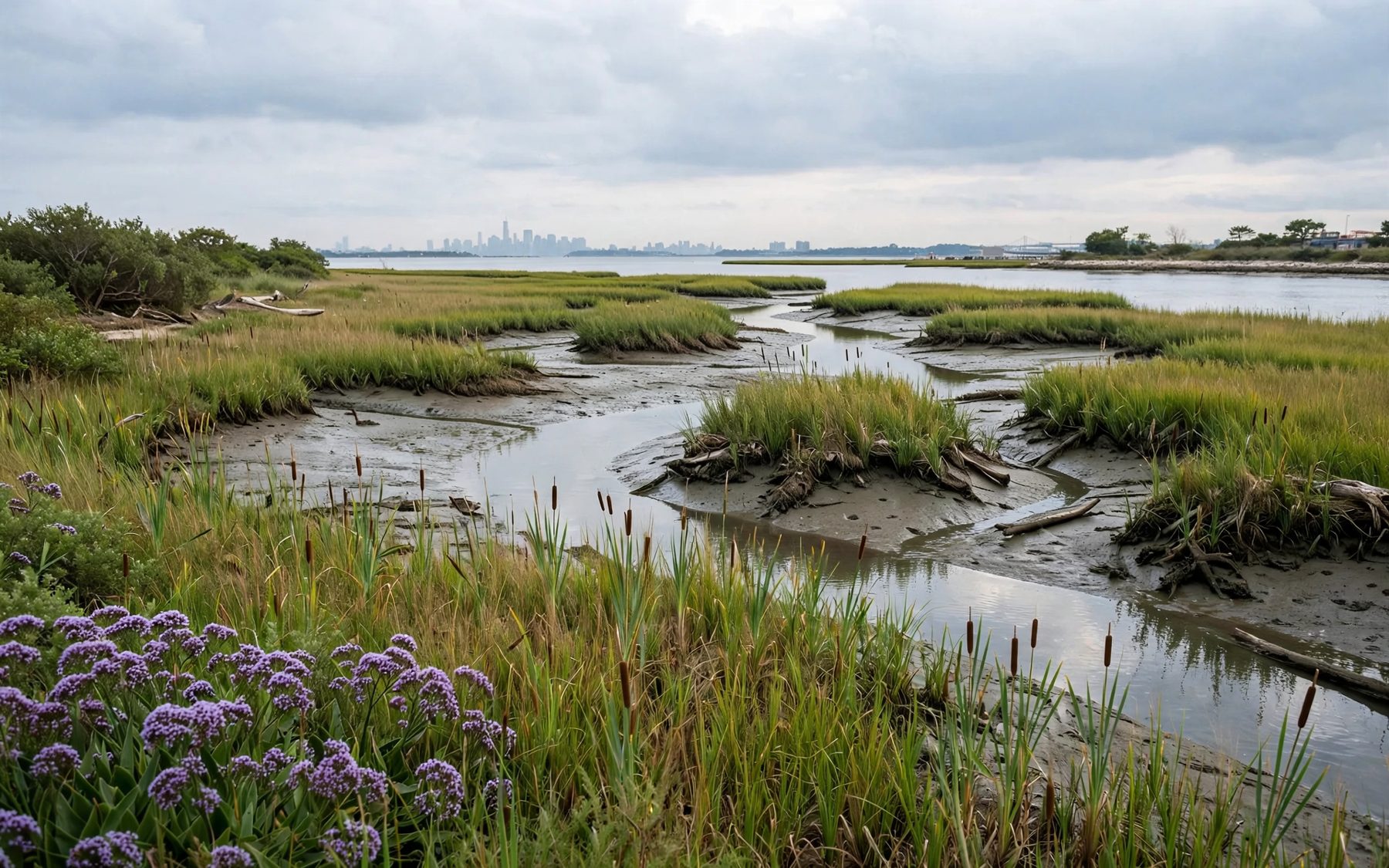
- A wet line on the cordgrass, exposed gray mud, crab holes, birds spread across the flats as the water drops and gathering as it rises.
- Best season
- April to October, falling tides
- Transit
- Varies by marsh; subway or bus
- From Midtown
- Any tidal marsh reachable by subway or bus
- Pack
- Tide times, binoculars, repellent, boots, water
A salt marsh at high tide and the same marsh at low tide can look like two different places. At the top of the tide the water spreads across the grass and the birds that fed on the flats are gone, crowded into a few high spots or off to rest. A few hours later the channels have drained, the mud shines, and herons, egrets, sandpipers and crabs are spread out across it. If you want to see marsh wildlife in New York, the most useful thing you can learn is how to read the tide.
Two highs, two lows, and a daily drift
Around New York the sea rises and falls twice a day. In roughly every 24 hours and 50 minutes there are two high tides and two low tides, about six hours and a quarter apart. Because that cycle is a little longer than a day, the tide comes about 50 minutes later each day. A low tide at 8 in the morning on Saturday will be close to 9 on Sunday, and in the afternoon a week later.
Tide predictions list the time and height of each high and low for a given place. Heights are measured from a local reference level, so a low tide may be shown as zero, a small positive number or even a negative number. You do not need to understand the datum to use the table; what matters is the time and how big the difference is between high and low.
Why the falling tide is the one to catch
The period when the water is going out is the best time to watch most marsh wildlife. As the tide drops:
- The mudflats along creeks and bay edges are uncovered, and worms, snails and small crustaceans are exposed for shorebirds to probe.
- Small fish are pushed out of the flooded grass into the narrowing channels, where egrets and herons wait for them.
- Fiddler crabs come out of their burrows on the uncovered banks to feed.
A good rule is to arrive two or three hours before low tide and watch the mud appear. At dead low tide the birds may be spread far out on distant flats, too far for comfortable viewing. As the water comes back in, it pushes them toward the shore again, so the first hour of the rising tide can also be good.
Some places run the other way. At a few spots birds gather to rest at high tide, crowding onto dry ground or into ponds near the bay; that is part of why the ponds at Jamaica Bay can be busy on the highest tides. The details for that refuge are in shorebird season on Jamaica Bay.
Compare plate VIIIThe cove at low tide: herons and the marsh edgeSpring tides and neap tides in plain words
The size of the tide changes through the month with the moon. Around the new moon and the full moon, the sun and moon pull in line, and the tides are larger than average: higher highs and lower lows. These are called spring tides, a name that has nothing to do with the season. Around the first and last quarter moons, the pulls partly cancel, and the tides are smaller: the highs are lower, the lows less low. These are neap tides.
| Moon | Tide type | What it means at the marsh |
|---|---|---|
| New or full | Spring tide | Very low lows expose the most mud; very high highs flood the marsh |
| Quarter | Neap tide | Less mud at low tide; the marsh floods less at high tide |
For shorebirds and crabs, a spring low tide uncovers the widest flats. For horseshoe crabs, it is the high tides that count: in late May and June they come ashore to spawn on beaches at high tide, especially in the evening around the new and full moons.
One city, many tide times
The tide does not arrive everywhere in New York at once. The water moves in from the ocean and travels up the harbor, up the rivers and along Long Island Sound at different speeds, so the timing and height of the tide vary from place to place. High tide in Long Island Sound, along the Bronx and Queens shore, can come hours later than at the harbor entrance, and the range there is often larger. Inside Jamaica Bay, the tide reaches the back marshes later than at the inlet.
So use tide predictions for the station nearest the place you are going, not a general figure for the city. Then allow for the weather: a strong onshore wind or a storm can hold water higher than predicted, and a long offshore wind can drop it lower. Predictions are a guide, not a guarantee.
Mud, ticks and what to carry
Tidal mud can be deep and sticky, and in places it will hold a boot or a leg. Do not walk out on mudflats, cross channels on a falling or rising tide, or step down from a path onto the marsh. Watch from trails, banks and boardwalks. Fragile marsh grass and the creatures in it are easily crushed, too.
- Binoculars. Birds on the flats are often far out; a pair with good magnification makes the difference.
- Repellent and long clothing. Mosquitoes and, in midsummer, greenhead flies can be fierce near salt marshes.
- A tick check. Ticks live in the grass along marsh edges from spring to fall.
- Water and sun protection. Marshes have little shade.
Rules, closures and visitor center hours change, so check the park's notices before you go. Then pick a falling tide, give yourself a couple of hours, and watch the water leave. The marsh at Gerritsen Creek on a summer evening is a good first place to try it.