i

Brooklyn · Brooklyn
Ospreys in Brooklyn: where they nest
- Range
- Brooklyn
- Habitat
- Salt marsh
- Coastal grassland
- Open bay water
- Field marks
- A large brown-and-white hawk hovering over shallow water, a bulky stick nest on a pole or platform, and loud whistled calls overhead.
- Best season
- April to August
- Transit
- Buses toward Floyd Bennett Field or Marine Park
- From Midtown
- Bus along Flatbush Avenue toward the bay
- Pack
- Binoculars, hat, water, repellent, patience
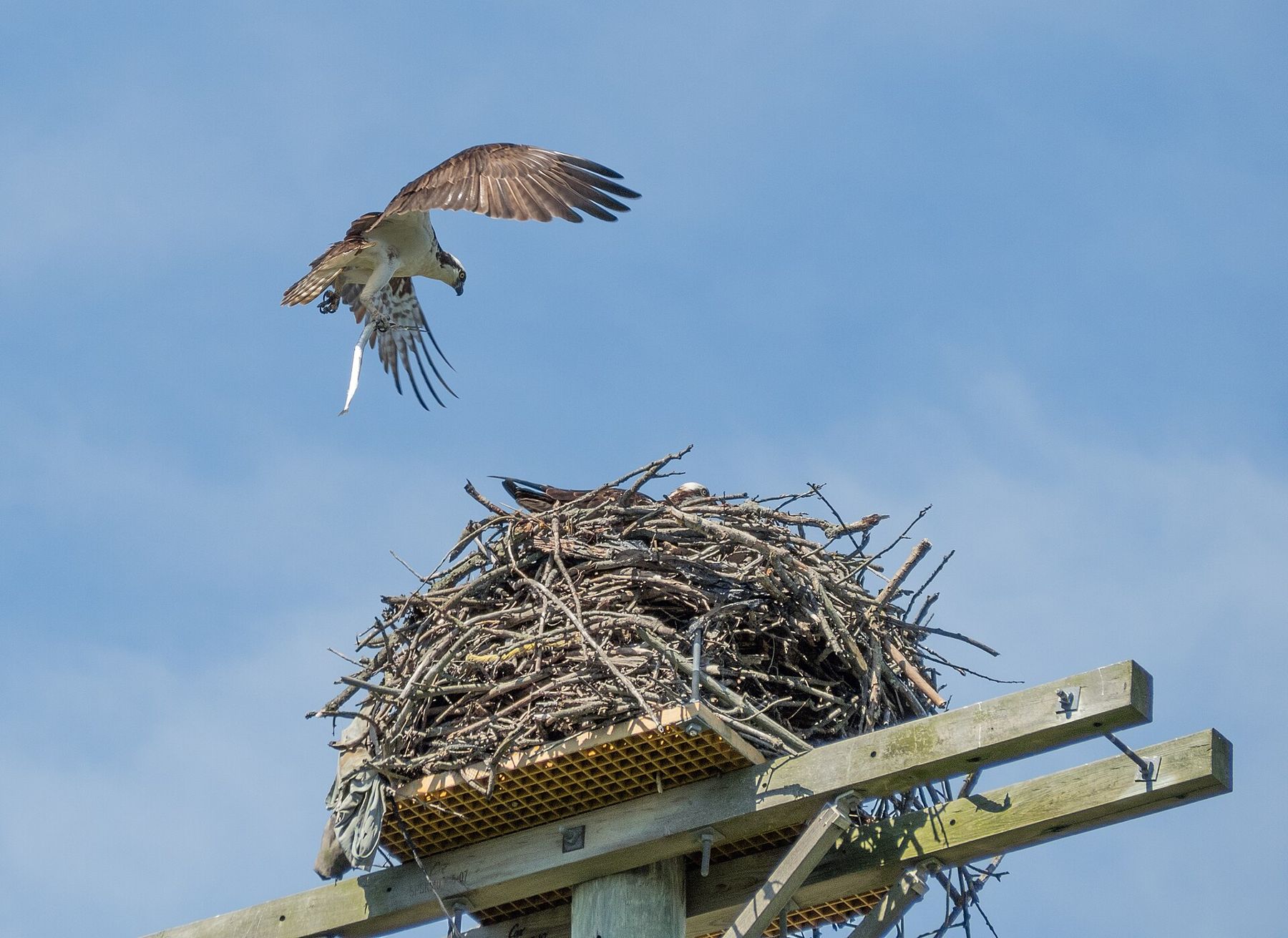
An osprey fishing is one of the great sights of the city's shoreline. A big bird circles over a channel, stops, hangs on beating wings, then folds and drops, hitting the water feet first with a splash and rising again with a fish held head forward in its talons. Around the marshes of southern Brooklyn and Jamaica Bay you have a fair chance of seeing it from spring into late summer.
A hawk that eats only fish
The osprey is a large raptor, with long, narrow wings that bend at the wrist into a shallow M when seen from a distance. From below it looks mostly white, with dark patches at the wrists and barring on the flight feathers. The head is white with a broad dark stripe through the eye, and the back is dark brown. Its call is a series of loud, high whistles, often given in flight near the nest.
Ospreys feed almost entirely on live fish, which they catch themselves. Their feet are built for it, with rough pads and an outer toe that can swing backward, so the bird can grip a slippery fish with two toes in front and two behind. Over the bay they take whatever fish are close to the surface in shallow water.
i
Platforms, poles and old nests
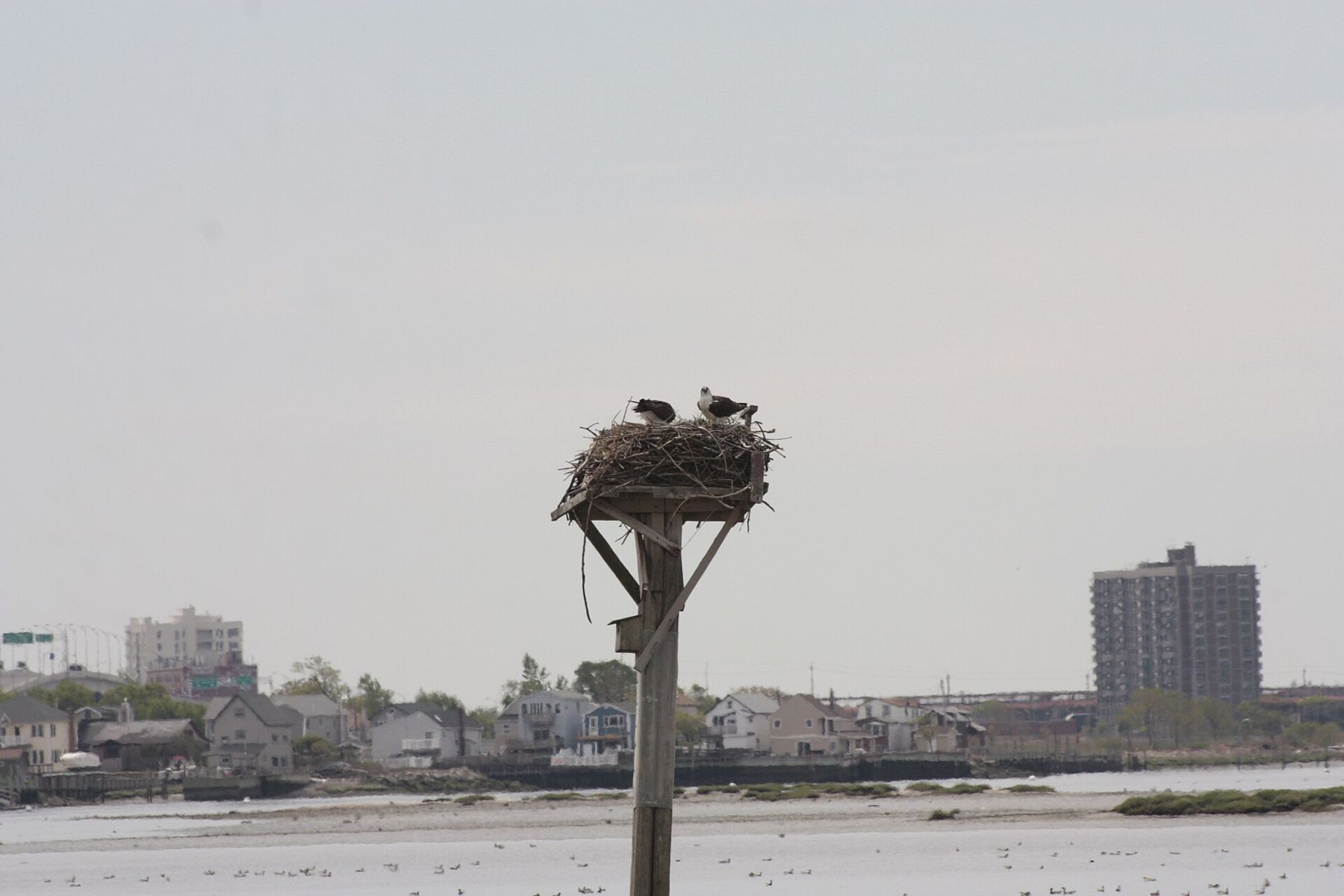
Ospreys build big, untidy nests of sticks, lined with softer material, on high, open structures near water. In the past that meant dead trees. Around New York today it often means poles: nesting platforms put up for them in marshes and grasslands, as well as light poles, towers and channel markers. Pairs often return to the same nest year after year and add to it, so a well-used nest can grow very large.
Platforms have been set up in several places around Jamaica Bay, including in the marshes near the refuge, in parts of Marine Park, and around Floyd Bennett Field, the old airfield on the bay's western edge. Floyd Bennett Field is now part of Gateway National Recreation Area, and parts of its open ground are managed as grassland for birds. From its edges you can scan the shoreline and nearby platforms. Check with the park for current access, since some areas close to protect nesting birds.
At Marine Park, ospreys hunt over Gerritsen Creek, and a walk on the nature trail along the creek often brings one into view. At the refuge in Queens, they are a regular sight along the West Pond loop in summer.
The calendar of a nesting season
Ospreys that nest here spend the winter far to the south, many in South America. They come back in spring, often around late March and April, with males usually arriving first. Pairs repair the nest, display over it and lay eggs.
Compare plate IIShorebird season on Jamaica Bay: what to look for in August| Roughly when | What is happening |
|---|---|
| Late March to April | Birds return, repair nests and court |
| April to May | Eggs laid; one adult is almost always on the nest |
| June to July | Chicks hatch and grow; adults bring fish often |
| July to August | Young birds start to fly and practice fishing |
| September to October | Most birds have left on migration south |
The timing varies from year to year and nest to nest. A late spring, a storm or a failed first attempt can shift the season, and not every pair raises young. In autumn, migrating ospreys from farther north pass along the coast, so you may still see one after the local birds have gone.
From near-loss to a common sight
Ospreys were not always this easy to find. In the middle of the twentieth century their numbers in the Northeast fell sharply. The pesticide DDT built up in the fish they ate and caused thin eggshells that broke during incubation. After DDT was banned in the United States in the early 1970s, eggs began to hatch again. Nesting platforms helped too, giving birds safe sites in places without tall dead trees. Over the following decades the population recovered, and the osprey is now a familiar bird of the region's coast.
That recovery is a reason to treat the birds with care, not to take them for granted. Nests still fail from disturbance, storms and fishing line woven into the sticks.
How close is too close
Watch from a distance that does not change the birds' behavior. If an adult on the nest stands up, calls repeatedly or flies off and circles overhead whistling, you are too close: back away. A nest left uncovered on a hot day or a cold, wet one can lose its eggs or chicks quickly.
- Stay on trails and outside any fenced or signed nesting area.
- Use binoculars or a telescope rather than walking nearer.
- Do not fly a drone near a nest. Rules on drones in parks are strict; check them, and in any case leave the birds alone.
- Pick up any fishing line you see along the shore, since it tangles in nests and on birds.
Shorelines worth scanning
Ospreys hunt where shallow water meets marsh. Good places in Brooklyn and nearby include the creek at Marine Park, the edges of Floyd Bennett Field facing the bay, and the bay shores along the causeways. The Jamaica Bay refuge itself, across the water in Queens, is just as good. A falling tide often concentrates fish in the channels, so it can pay to check a tide table before you go.
Bring a hat and water, since these are open, sunny places, and repellent in summer for mosquitoes and greenhead flies. Keep to the paths, check for ticks after walking through grass, and look up often. No sighting is promised, but in the right season an osprey is one of the more likely big birds you will see on a Brooklyn shoreline.